Showing posts with label half-assed tutorials. Show all posts

Tuesday, December 21, 2010

Last Minute Gift

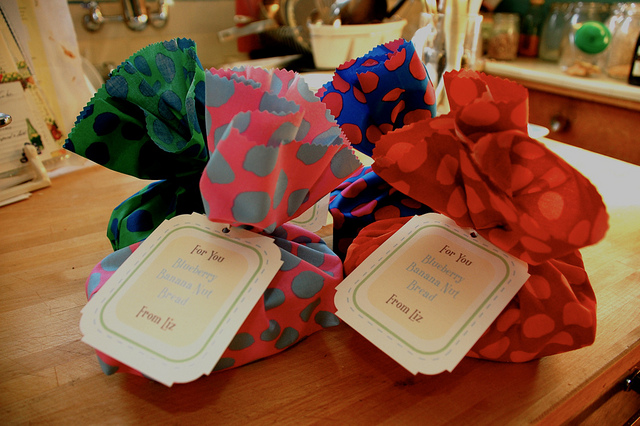
Last week I made some little gifts to give to friends.  The recipe is for banana nut bread that my mom used to make a lot.  I think the original recipe came from one of those homemade cookbooks from a church or a school.  She always added frozen blueberries and I remember several of these wrapped up for teacher gifts when I was young.
DSC_0034

I also whipped up some little fabric bags to wrap them in and made some gift tags.  The bags fit a mini loaf pan.
To make the bags cut a 20" x 10" piece of fabric.  Fold the fabric in half, right sides together lengthwise and sew up the sides.  Flatten out the corners of the bag, still inside out, so that the seams are centered.  Sew straight across each point, perpendicular to the seams, about 2 inches in from the points.  Trim the points, turn the bag right side out and trim the top with pinking shears.


Click here to download your very own gift tags.  (I took my name off of them, don't worry.)

Blueberry Banana Nut Bread

This recipe makes two regular sized, 2 pound loaves or 4 mini loaves.  I used disposable aluminum pans to give as gifts.

1/2 cup (one stick) butter, room temperature
1 1/2 cup sugar
2 eggs
1 tsp vanilla extract
2 mashed bananas (bananas that have turned black on the outside are great for nut bread)
2 cups flour
1 tsp baking powder
1 tsp baking soda
1/2 tsp salt
3/4 cup milk
1 tsp lemon juice
1/2 cup chopped walnuts
1 cup frozen blueberries

Preheat oven to 350 degrees.
Cream together butter and sugar.
Add eggs and vanilla and combine.
Add mashed bananas and combine.
Sift dry ingredients.  Add lemon juice to milk and let it sit for 5 minutes.
Add dry ingredients to creamed mixture, alternating with the milk and lemon juice.  Mix until combined.
Gently stir in the nuts and blueberries.
Pour into 4 greased mini loaf pans.  Bake for about 50 minutes or until a toothpick stuck into the middle of a loaf comes out clean.

Wednesday, December 01, 2010

Have no fear.

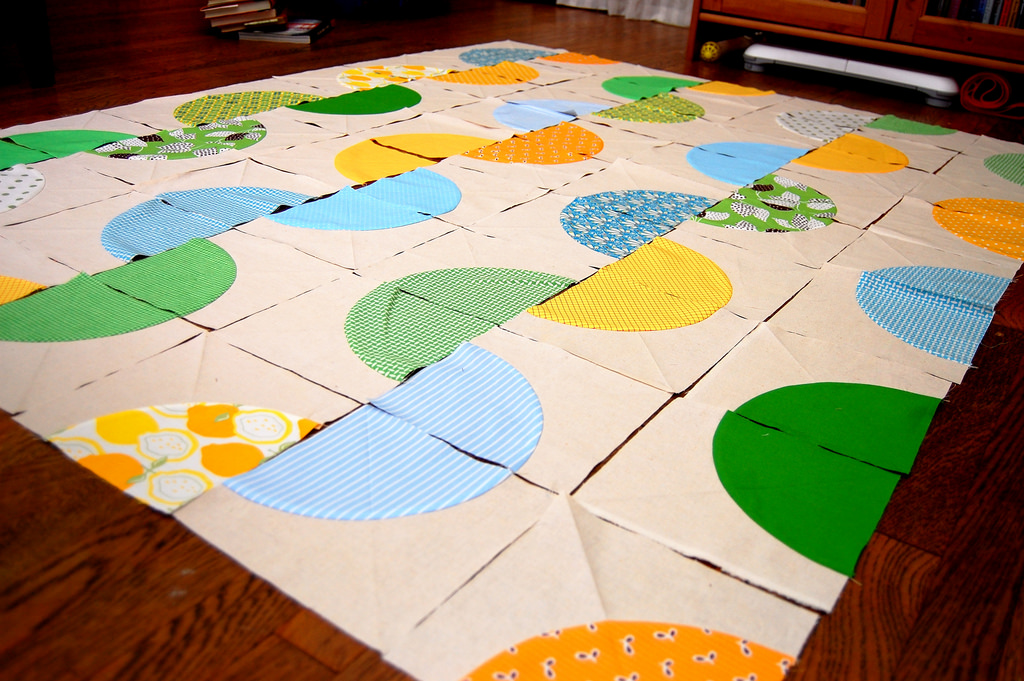
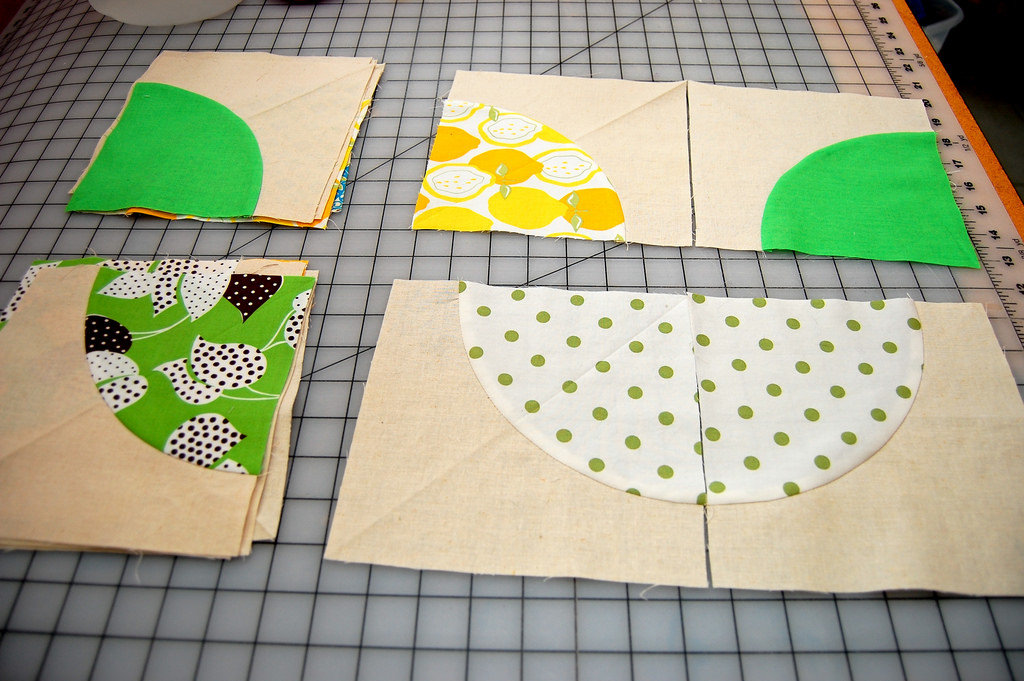
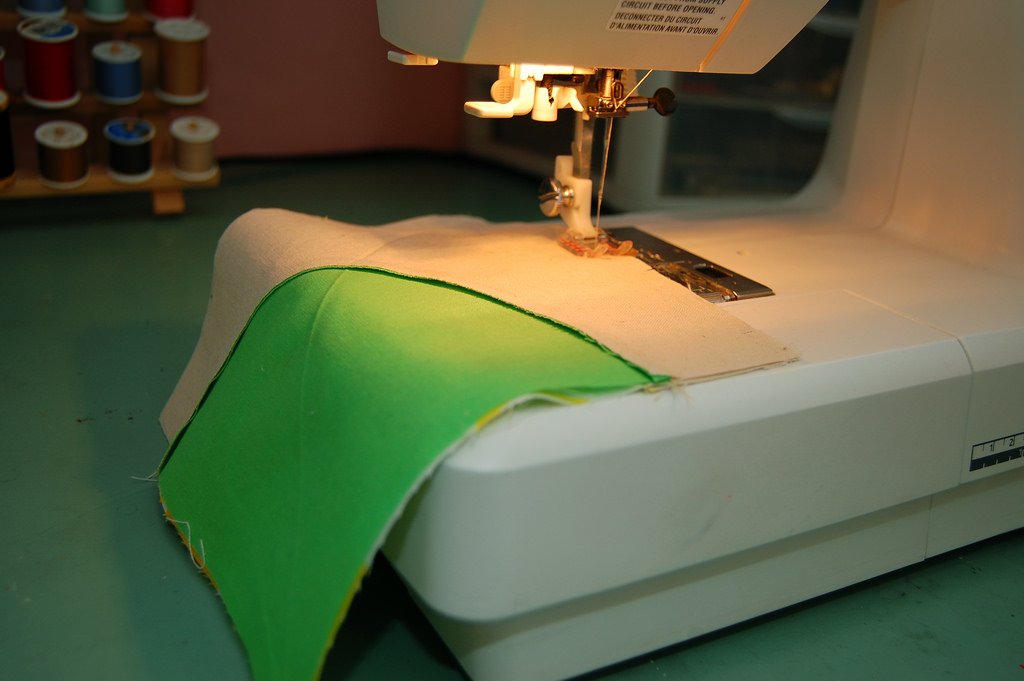
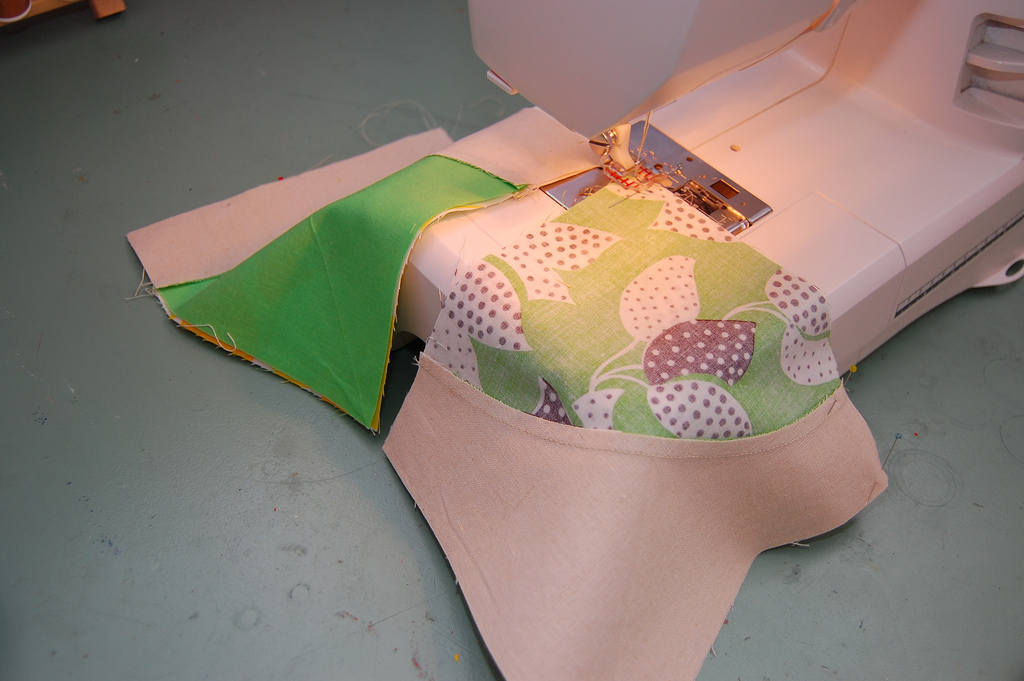
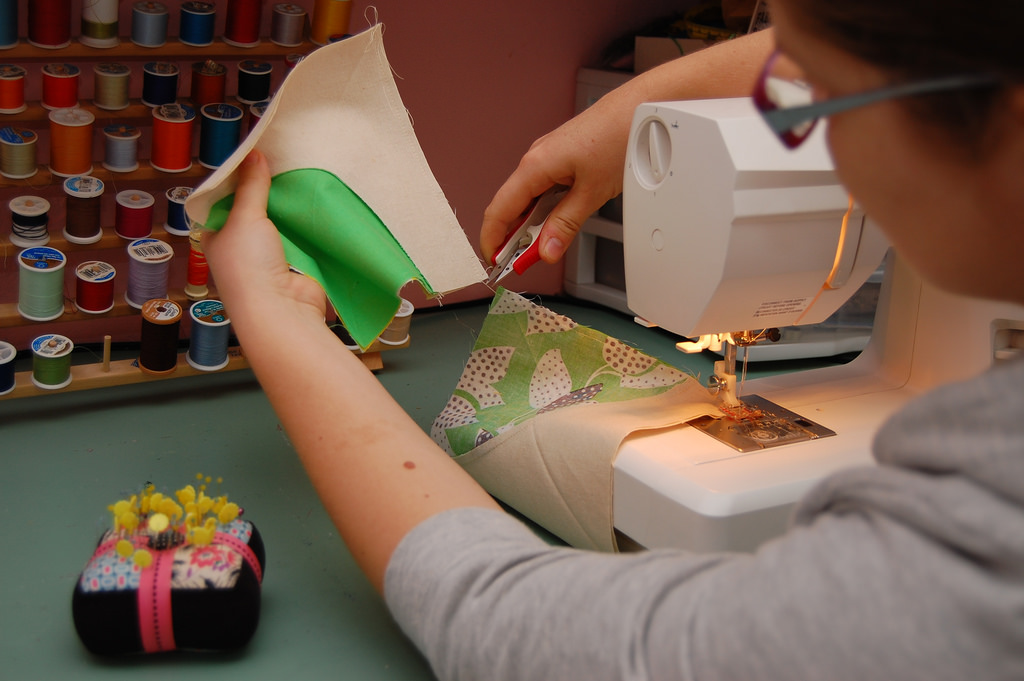
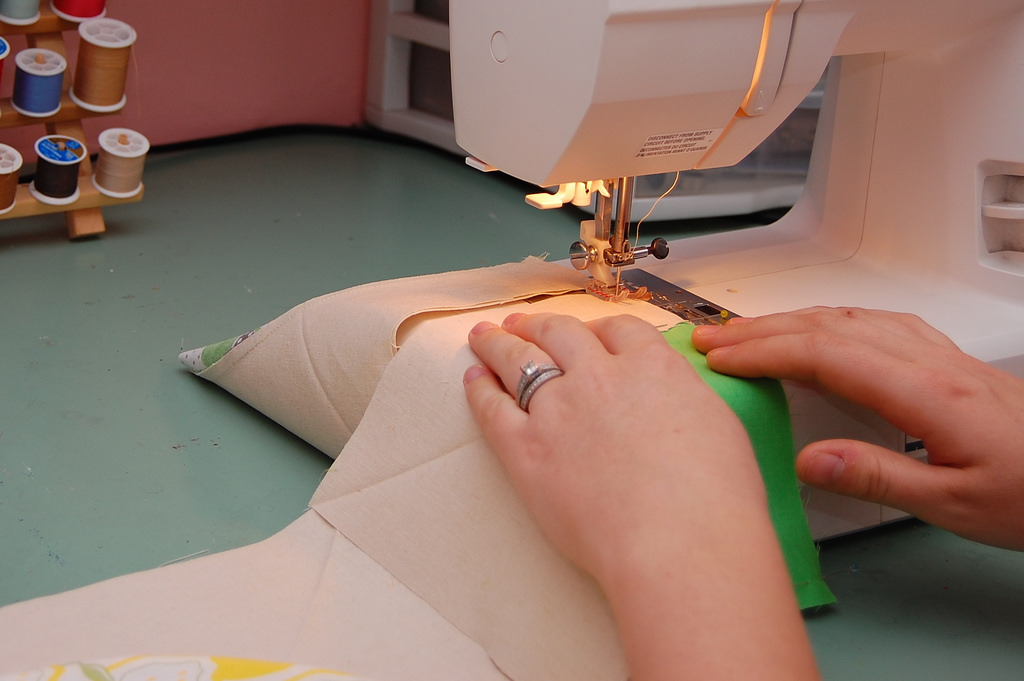
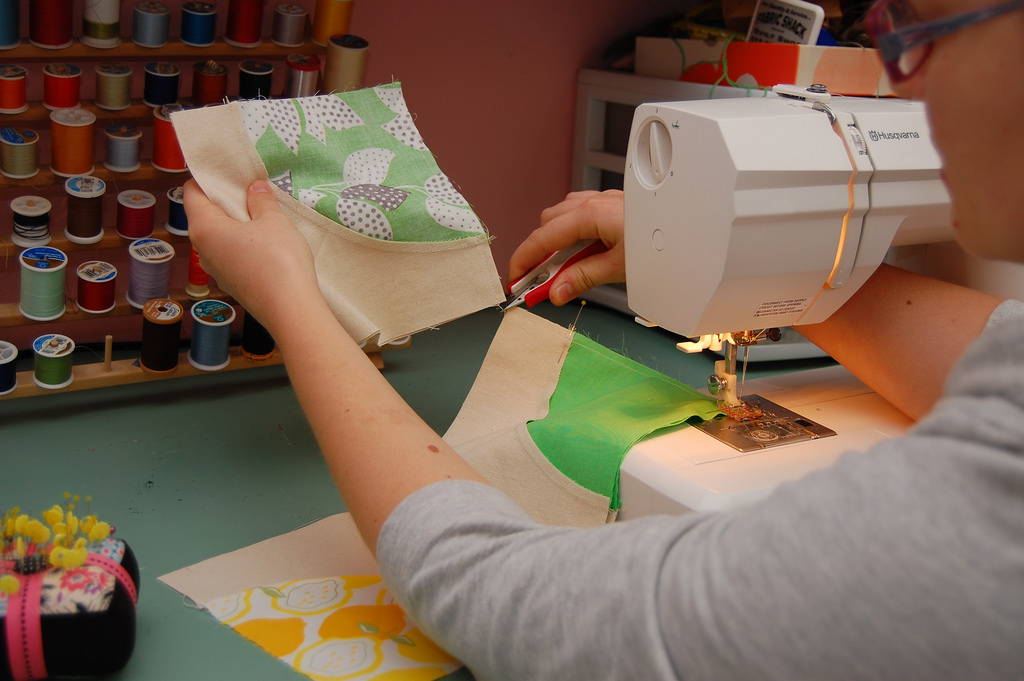
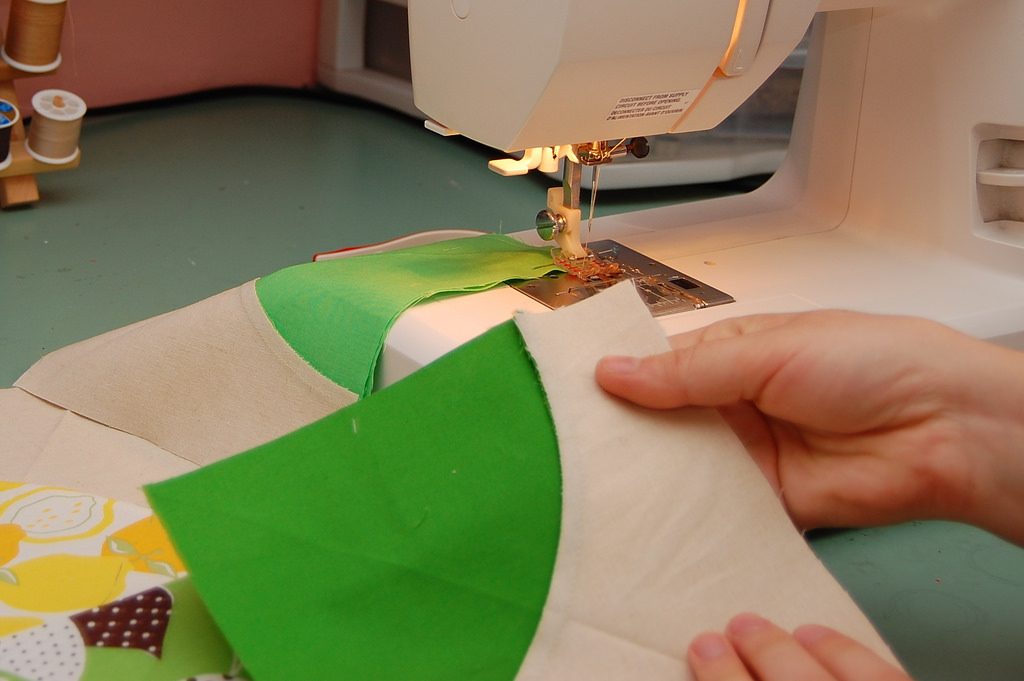
As I suspected, there are several of you out there who are intimidated by piecing curves.  I am here to put your fears at ease.  This video will walk you through not just piecing curves but piecing curves in the laziest way possible, with almost no pins!  I hate pinning and I love piecing curves so really, you've got the best of both worlds right here.  I'm demonstrating using pieces from my Christmas version of my Mod Beads pattern.  I hope some of you find this helpful!


Tuesday, March 30, 2010

Chain Piecing

First, a work in progress:
In Progress
This one really will be given to a baby, I swear.  I'm not going to keep it, like the dots.

Second, I thought I would show you how to do something called chain piecing.  I'm sure most of you know how to do this already.  In fact you could quite possibly be doing it without knowing that it's called chain piecing.  It's a handy little trick that makes piecing a quilt top go faster and more efficiently.  I love tricks like this.  I like to be efficient.  A lot.

This is a good trick to use when you're piecing two or more sets of something, the simplest example being multiple rows of a quilt.

For this quilt I'm piecing together each column, starting on the left and piecing from the bottom to the top.
The whole idea of chain piecing is to allow yourself to keep sewing without cutting the thread after each seam.  To do this you piece together two or more rows at a time.  I'm starting with my first two columns.  The stacks on the left are in the order that I want to piece them.  We'll call them stack A (on top) and stack B (on the bottom).  To the right are the first two pieces from each stack that I'll be sewing together.
How to Chain Piece

First, sew together the two pieces from stack A.  When you're done DON'T CUT THE THREAD!  Just leave it there, sitting pretty.
How to Chain Piece

Then take the first two pieces from stack B (I know these are different than in the first photo, that's my mistake.  Nobody's perfect, right?) and sew them together.   Again, don't cut the thread.
How to Chain Piece

Now I've got the first two columns connected but I'm ready for another piece from stack A.  So, I just snip the little bit of thread between the two, leaving the second pair still on the machine.
How to Chain Piece

And voila, I'm sewing on a third piece from stack A.
How to Chain Piece

That's done, snip B off the back, leaving A on the machine.
How to Chain Piece

Ready to sew another block onto B.
How to Chain Piece

You're just leap-frogging between A and B, snipping off the end of the chain and bringing it to the front.  In theory you could do this with all of your rows at once, it just might get a little confusing trying to keep straight all of those piles and what row goes with what.  I will do it with three stacks though, especially on a quilt like this with an odd number of columns.  I don't want that last column to be left all by his lonesome with no one to be chained to.

Wednesday, March 24, 2010

Hexagonia

It's a disease.  Where you just want to sew hexagons.  I think a lot of people have it.  I don't.

At least I didn't until I figured out a way to piece hexagons with my machine as opposed to fiddly little English paper piecing.  Hand piecing is just not for me.  I've tried it, it's ok, I just can't keep it up for the long haul.
And so:
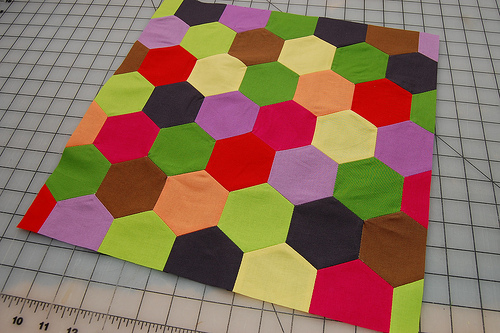
Machine Pieced Hexagons
This is a Bee block for the queen of solids, Latifah, of LAMQG fame.

Would you like to try?  If so, I've got some treats for you!

Number 1, presenting the first ever Lady Harvatine instructional video:


I'm sorry that things aren't totally in focus the entire time.  I'll do better next time.

Treat number two is a pdf file of hexagon templates.  You can print and cut out 4", 3" and 2" hexagons, all with a 1/4" seam allowance included.

Download the pdf file here.

I hope the video is clear enough.  Please ignore my horribly ragged finger nails.
Let me know if you have any questions!

Monday, September 14, 2009

New Addition (Part 2 of 3)

Ok, it's not Friday as originally promised but you've probably come to expect such tardiness from me.
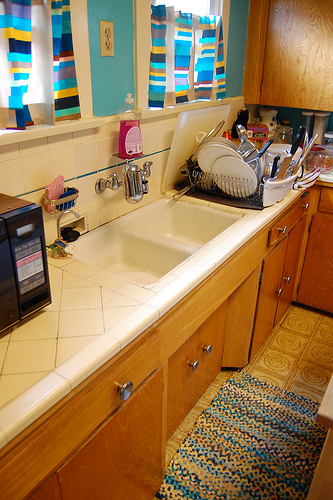
After hanging my lovely new kitchen curtains, my eyes fell upon the sad, ragged, always dingy kitchen rug. It simply would not do.

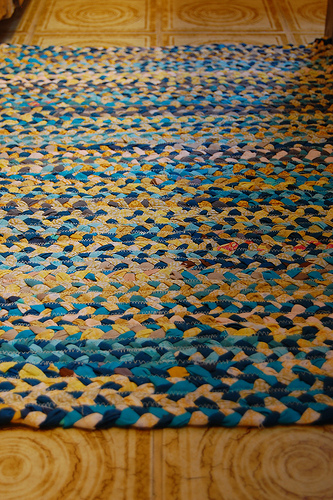
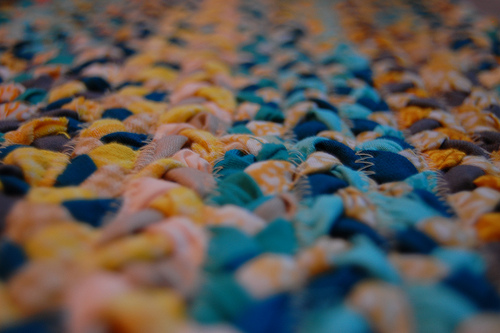
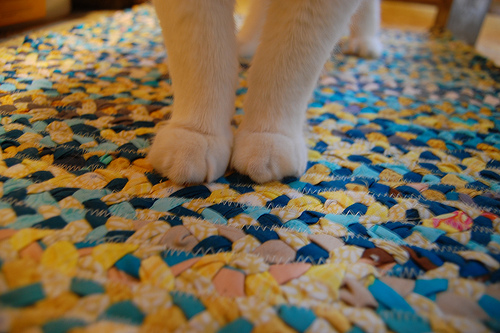
This rug is made from curtain scraps and fabrics chosen to match, all of which I had on hand. The fabric was cut in two inch wide strips and braided together. When I reached the end of a strip I just added a new one, overlapping about an inch.

When I had a lot of braid, I started sewing rows together, using the zig-zag stitch on my machine. My rows are 21" wide. I sewed almost to the end of the braid and needed more so I kept braiding.

Some tips if you want to try making your own rug:
  1. This is a super way to use up fabric that you don't really like. As long as the colors work, the pattern is indistinguishable once it's braided.
  2. Never have a made something more conducive to watching movie upon movie while working. This takes .2% concentration.
  3. You may have to lift your presser foot to get the rug underneath. I didn't even know that was possible until making this rug!
  4. Speaking of presser foots (feet? No, foots), after lifting it and cramming your rug underneath it, you may forget to then lower the presser foot lever as the foot itself already appears to be down. Do not be fooled! You must still lower the lever for if you do not you will encounter (seemingly)inexplicable tangled mess after tangled mess. Not that it happened to me. No no. I just heard that it could happen. From my friend. Biz.

Part 3 of 3 tomorrow, I swear! And man is it the best of all parts!

Monday, April 13, 2009

Back to Bubbles

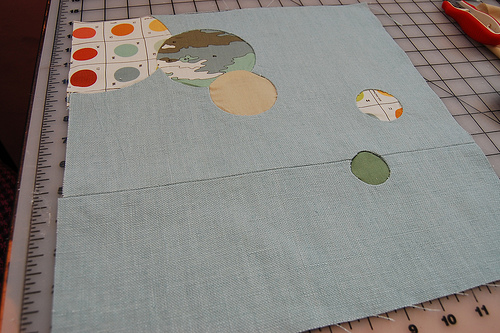
I recently played major catch up (though I'm still not quite caught up) on my Common Threads bee blocks. You can see the whole lot here.
This is the last one I finished.

It's for Jacquie who is making a quilt for her teenage son. The instructions were "minimal, modern and masculine." The inspiration for this design came partly from reading about Dale Fleming's technique for sewing pieced curves which I found here at Dioramarama.com. If you want to learn this technique you can visit either of these sites for thorough instructions but I thought I'd walk you through the basics of this block. It was a little different because of the multiple overlapping circles. If this all seems confusing you should visit one of the above links. Then it'll all make sense, I swear!

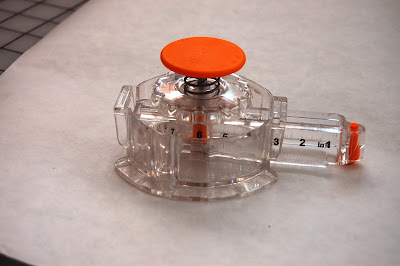
To cut out my circles from the freezer paper, I used this handy dandy tool. It works ok. Better on smaller circles than large ones. You could use scissors as well as long as you draw a perfect circle on the paper to cut out.
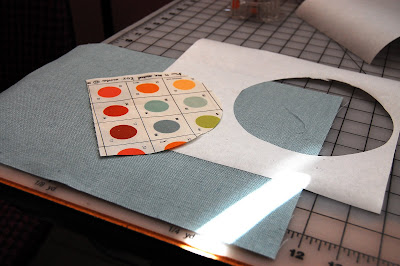
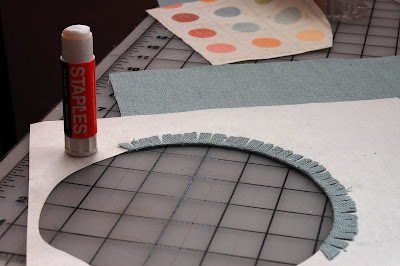
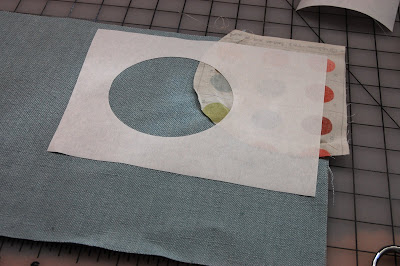
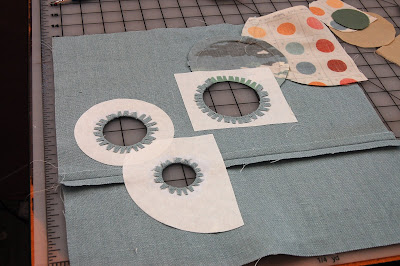
I started with the circle in the corner since it was on the "bottom" of all of the overlapping circles. I cut out the size of circle I wanted from freezer paper and ironed the shiny side to the wrong side of my background fabric like so, positioning the hole where I want the pieced circle to be.

The piece of colored dot fabric is what I'm going to piece to the background. It's about 1/2 in bigger all around than the fabric you see inside the circle.
Next, I cut away the BG fabric inside of the circle, leaving a roughly 1/2 in seam allowance.
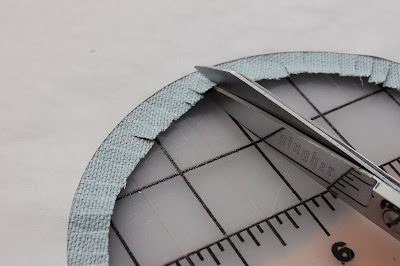
Then I clipped the curve right up to the paper, all the way around.

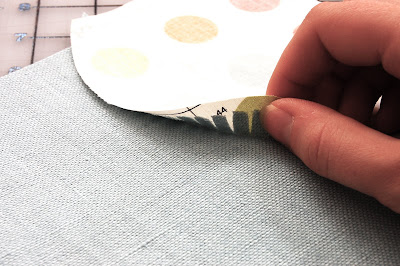
Next, I took a glue stick and glued the clipped edge to the back of the freezer paper. This should make a nice smooth curve if you look from the other side.
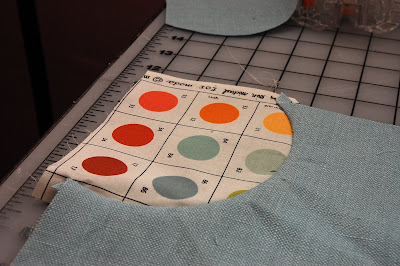
When that glue was dry (which only takes a few seconds) I applied more glue to the back of the clipped fabric which I pressed the colored dot fabric to, thus allowing me to remove the freezer paper all together.

Tada. Unfortunately I have no photo of the actual sewing. You press and sew along the nice little crease you've got there, all the way around your circle, or semi-circle in my case. Flip it over and voila.

To make an overlapping circle I just placed my next freezer paper stencil over the seam, doing everything the same, treating the pieced er, piece as a solid background.
This only got tricky when it came to gluing the seams down. Because there were multiple layers of fabric I had to do some creative trimming. Also, this background fabric was some thick-ass linen! Things got a little bulky which is why some of my circles aren't exactly perfect. I would not do this again with fabric like this. Cotton on cotton though would be much less of a hassle.
I did the last three circles all at once since they weren't overlapping each other at all. The smaller circles were harder to sew than the large ones.
And that's it! Again, this is no where near a comprehensive tutorial so if you really want to try this technique visit the links above.

Friday, July 25, 2008

You look thirsty.

Let me get you a drink.

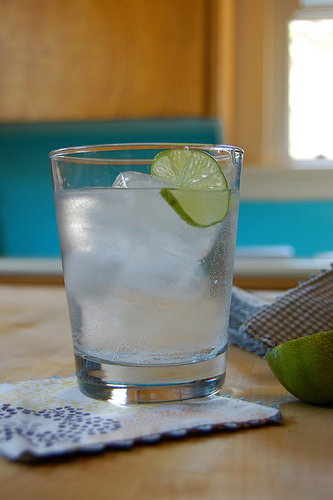
Oh, I'm so sorry, you're glass is sweating! It is horribly hot today. Here, have a cocktail napkin.

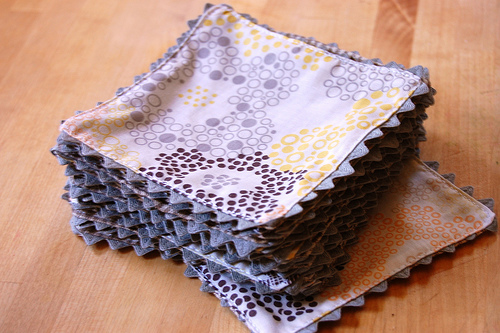
What's that? Why yes, I did make them, thank you for noticing!

Oh, it was quite easy. I could show you if you wanted.

Really? Okay then, let's!

For each napkin you will need
  • two 4.5" squares of fabric, either the same print or two complimentary patterns
  • 20" of rick rack
  • a good stiff cocktail (I find a vodka tonic works well)
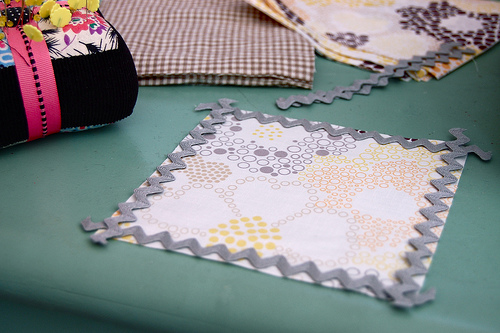
  1. Cut the rick rack into four 5" pieces and lay them out on each side of one of your fabric squares, right side up. How close it is to the edge depends on how wide your rick rack is. Mine was the regular size and I lined it up with the raw edge of the fabric. If your's is jumbo it may have to overlap the edge.
  2. Lay your other square on top, right side down and pin together, making sure to catch the rick rack with your pin. I only pinned the corners but you can do more if you like.
  3. Sew a 1/4" seam around all four sides, leaving a 3" gap on one for turning.
  4. Trim the corners and turn right side out. Poke out the corners and press. Sew a seam close to the edge of the fabric all the way around the napkin, closing the gap.
  5. Have a drink and admire your work.
  6. Optional: Make a drink for a friend and ask him/her to admire your work.

Thursday, May 08, 2008

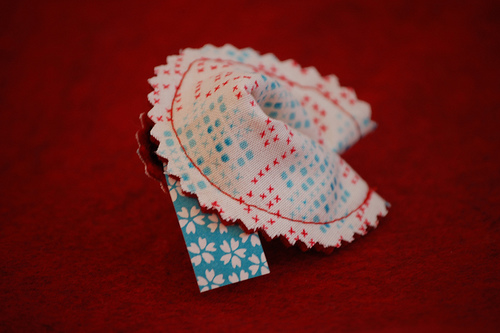
Fabric Fortune Cookie Tutorial

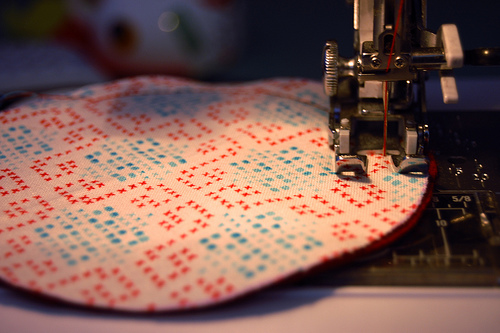
When Sew Mama Sew started their tutorial contest I thought "Great! I will write a tut' and enter." So I took some pictures of the process I use to make my fabric fortune cookies. Then...I let them sit there. And now the contest is over. Which is really okay. The real motivation for me to enter things like this is to share with people who don't ordinarily read this blog, not to win. So in the continued spirit of not winning anything I present you with the "Lady Harvatine Style Fabric Fortune Cookie Half-Assed Tutorial".

You will need:
  • a 5 inch square of cotton fabric for the outside of your cookie
  • a 5 inch square of felt for the inside
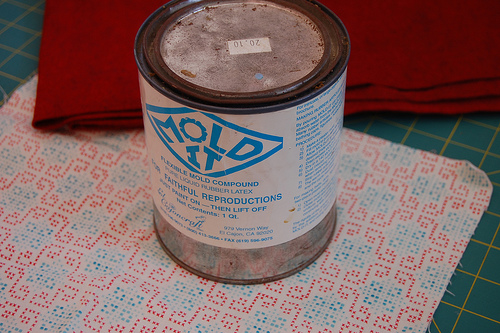
  • a circle to trace, one with a diameter of about 4.5 inches (I use an old paint can)
  • pinking shears
  • a slip of paper, about .5" by 2.5" for your fortune
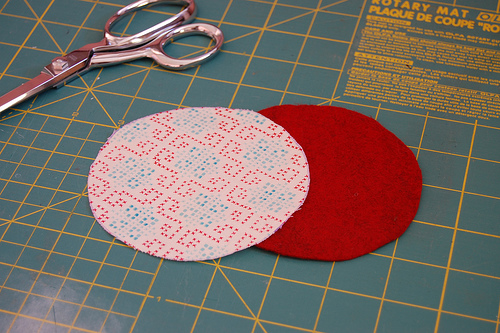
Trace a circle onto both your cotton fabric and your felt.

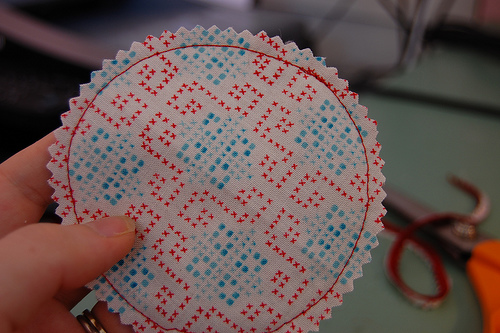
Cut both circles out.

Lay the cotton on top of the felt, right side up, and line up the edges. Sew a half inch seam around the entire circle. I use my walking foot for this but you don't have to.

Use your pinking shears to trim the raw edge all the way around the circle, leaving about a quarter inch of fabric.

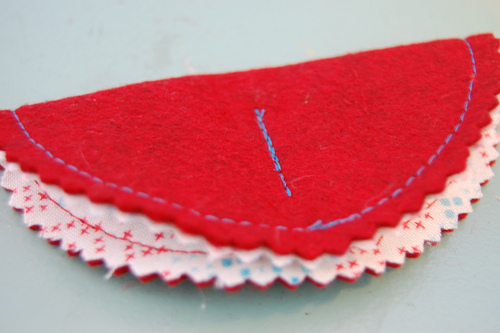
Fold the circle in half with the cotton side together, felt on the outside. Sew about an inch seam down the middle, not sewing to the edge of either side of the half circle. Be sure to back stitch a few times.

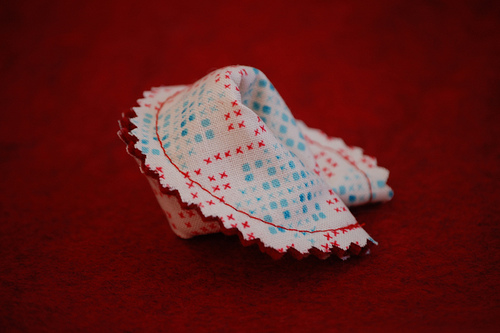
Flip the cookie open and adjust the folds until it looks right.

Before you give it to someone be sure to write a fortune on a slip of paper and stick it inside. I like to use pretty origami paper that is blank on the back.

You can also string a piece of ribbon through the center of the cookie and tie it to a gift, like so.

Ok, the end, happy cookie making!

Monday, October 01, 2007

Make Your Own Fall

As a New Englander stuck in LA, I get most homesick at this time of year. LA knows no fall. There's no such thing here. It's kind of like summer stops and then...nothing. It's not hot anymore but nothing really changes. When four distinct seasons have been ingrained into your soul every year since you were born it can be very hard to do without. It's kind of like living in a time vacuum. There are no signs that time is passing.
The other day I saw that they were selling cute little gourds and pumpkins at Trader Joe's and it reminded me of the first fall we spent out here, two years ago, when I first bought little gourds and pumpkins at that very same store. The memory made me very excited. It actually gave me that feeling I've been missing. It gave me a sense of a new kind of fall, in my new(ish) life in LA. Even though there are no changing leaves, the change in produce works for me and I'll take what I can get.

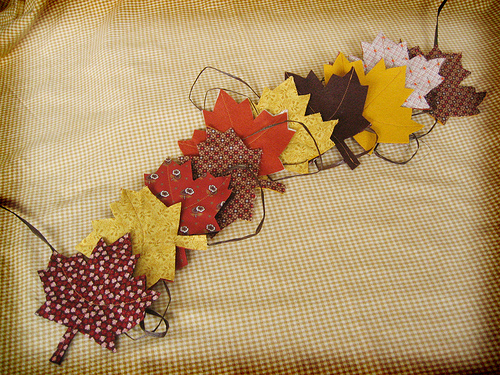
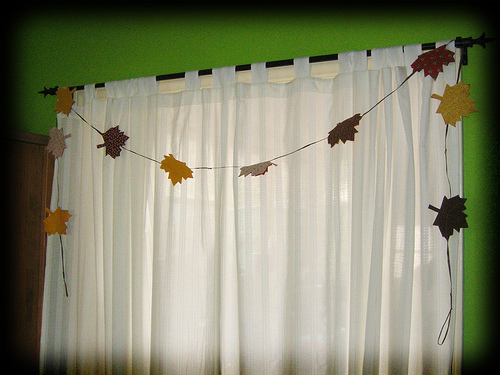
Since I need to cobble together some semblance of a New England fall here, in addition to my gourds I'll hang this sweet little garland that I made last year. It was as easy as pumpkin pie to make so I thought I would share a little "you-know-what" tutorial with you.

You will need:
  • several different patterned cotton fabrics in fall colors (I didn't use fall novelty prints. I don't like to be too literal.) The colors I used were dark brown, goldie yellow and dark orange with a little red in some of the fabrics.
  • several different colors of wool or wool blend felt, all in fall colors (the number of different fabrics is up to you)
  • 11 feet of natural or brown raffia (you can get this at any craft store)
  • thread, also in a fall color
  1. Click here for the leaf template.
  2. Print out the template and cut that baby out.
  3. Using the template, cut out ten leaves from the cotton fabric and ten leaves from the felt.
  4. Pin cotton/felt pairs of fabric together, right sides facing out, sandwiching the raffia between the two. Space the leaf pairs one foot apart, leaving one foot of raffia on either end of the garland. Don't line the leaves up, all pointing in the same direction. Make them a little more random (like they're falling!).
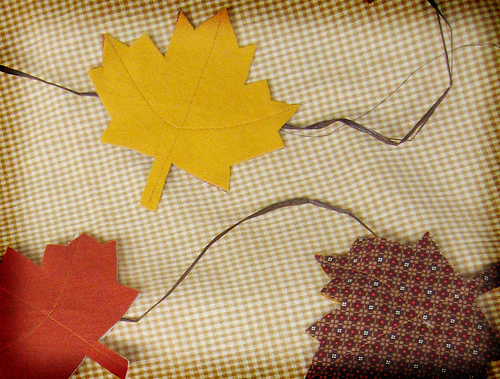
  5. Top stitch through the leaf sandwiches mimicking the veins of a leaf (see the picture below), being sure to catch the raffia.
Ta-da! You're done. Hang it up and take a picture!

(Seriously though, send me a picture.)

Sunday, June 24, 2007

Summer Slippers

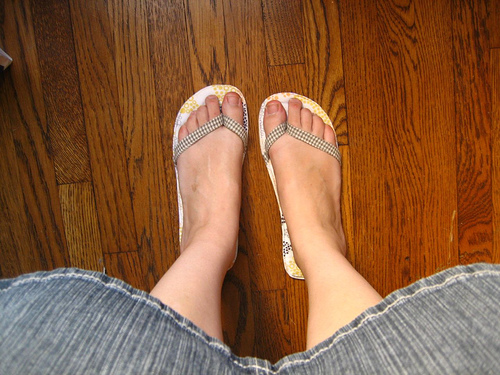
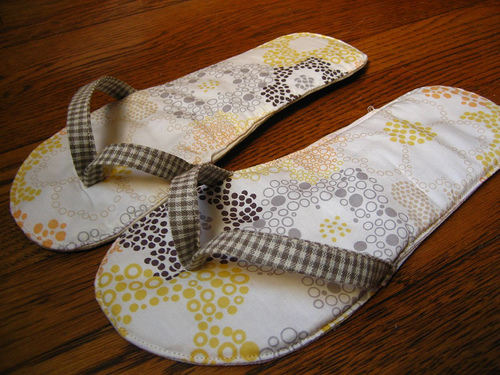
It's hot here. Very hot. And it's only going to get hotter as the summer goes on. So what's a gal to do when she wants to shuffle around the house in her comfies but it's to hot for her trusted slippers? She makes summer slippers! These slippers give you something soft and stylish to lounge around in while trying to stay cool.


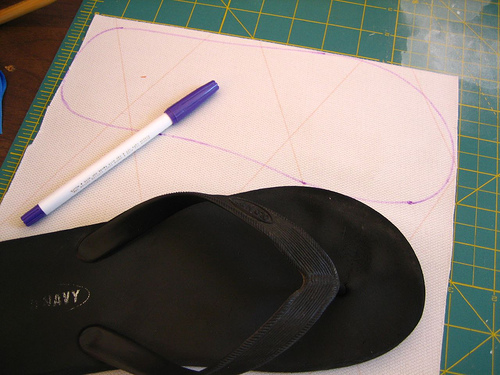
You will need: at least one flip flip that fits your foot, some vinyl, cotton fabric for the top of the slippers (call it your main fabric), muslin or something that kind of matches your main fabric (this fabric is not meant to be seen but you might get a little bit peeking out of the edge of your slippers so pick something that will be camouflaged), bias tape 1/2 inch wide or fabric to make your own bias tape, for the straps and batting (I used polyester because it is fluffier and it will hold up better under my feet).

Also handy: disappearing fabric marker, bias tape maker (if you're going to make your own) and a walking foot for your machine. You don't have to use one but I did. Now that i have one I find myself using it more often than not. It's awesome.


1. On the back side of your vinyl, plop down your stinky old flip flop and trace the sole using a disappearing marker. Now fold the vinyl over on itself, right sides together and pin around the sole outline so you have two layers of vinyl. Don't pin inside of the outline because the pins will leave visible holes in the vinyl. It doesn't bounce back like regular fabric. Once you're pinned, cut along the outline. Now you have a sole for each foot!
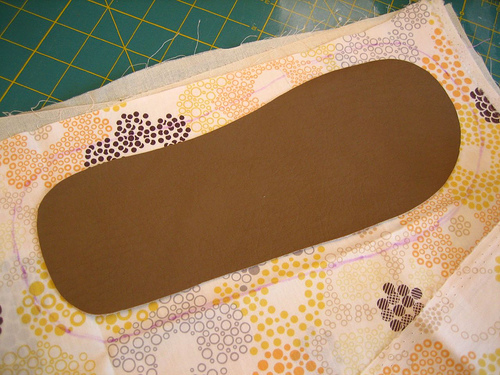
2. Use one of your vinyl soles as a template and lay it over your main fabric and your muslin, each folded in half, right sides together. Trace around the soul, about 1/2 in away from the edge of the vinyl. This does not have to be perfect. If you're scared, give yourself more than 1/2 of an inch. Now pin it all together and cut on the line.
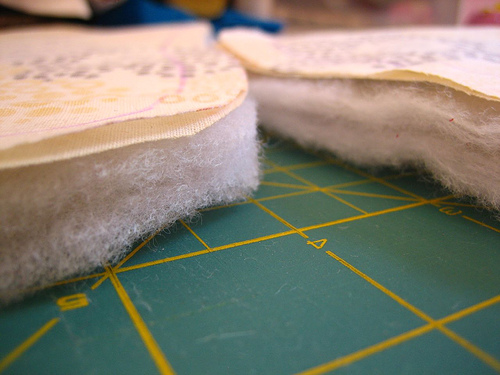
Repeat this step with the batting. I used two layers of batting for each slipper which means you need to cut out four pieces. Remember to add the roughly 1/2 in seam around the batting as well!

3. Layer your pieces as so: two pieces of batting on the bottom, muslin in the middle and main fabric, right side down, on top. Be sure you've got right and left foot accounted for. Pin it all together (I didn't...I'm sorry, I'm reckless).
4. Now take one of your vinyl soles and center it over one of the little stacks that you just made. Trace around the exact edge or the vinyl, then put the vinyl aside. This is your sewing line. Sew along that line, around the entire perimeter of the stack, leaving a two to three inch opening on one side for turning.
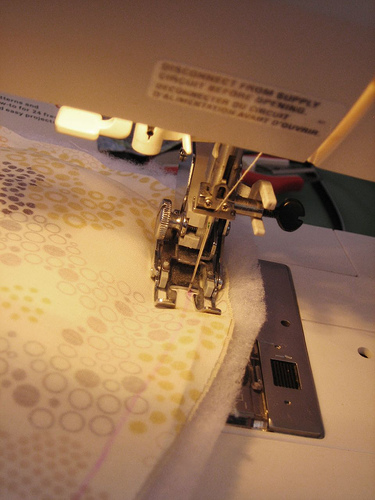
Repeat with the other stack.

5. Trim the seam allowance to 1/4 of an inch on both slippers.
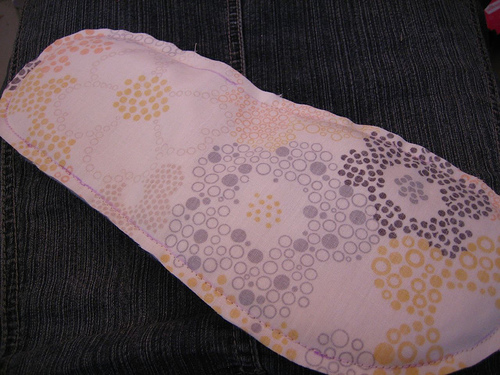
Now turn the insole right side out, so that the main fabric is on top, the muslin is on the bottom and the batting is in the middle. Make sure that the seam allowance on the opening is tucked inside, feel free to press it if you want.

5. For the strap, I made my own not-on-the-bias tape (it doesn't need to be cut on the bias for this). I cut a two inch wide strip of fabric,
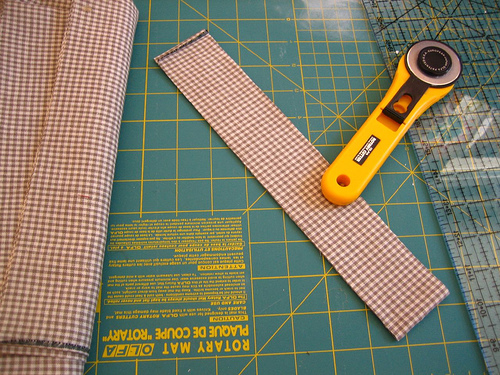
then I fed it through my bias tape tool and pressed. If you don't have one of these, for this project you can just fold the two sides of the strip into the center and press.
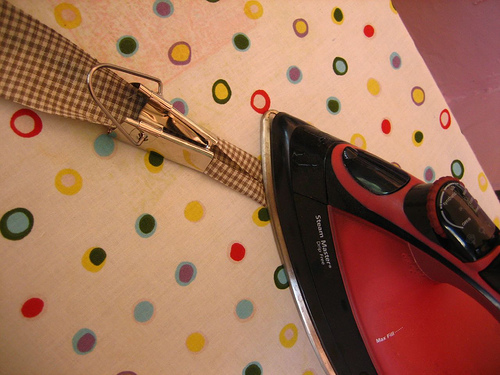
Then fold the whole thing in half and press, so that you have half inch tape. You can of course use premade bias tape.
Next, sew along the open edge of your tape like so:
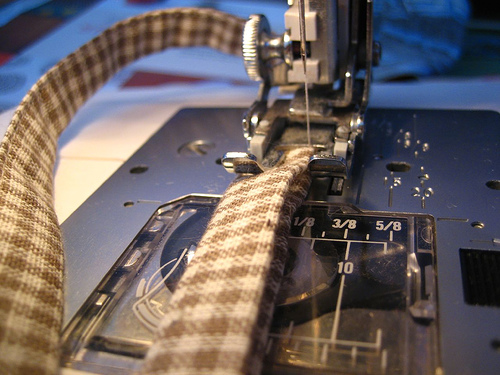
You need 12 inches of tape for each slipper.

6. Put your turned out insoles on the floor and center your feet over each one. With your disappearing marker, make a mark in between your first and second toes on each insole. This is where you are going to sew down the center of your strap.
Cut a 12 inch piece of the strap. Pin the strap to the insole where you marked between your toes. The strap should be perpendicular to the insole (like a cross) and there should be five inches of strap pointing towards the inside (where your big toe is) and seven inches of strap on the other side. Sew over the strap at the between your toes mark, back stitching several times.
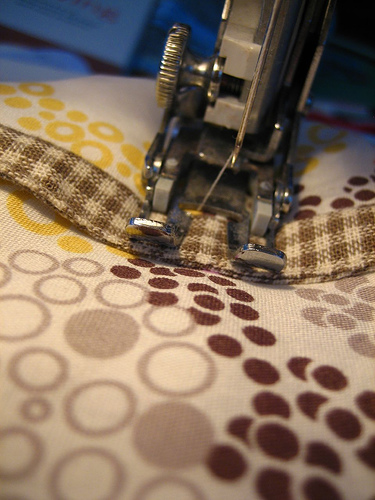

7. Put the slipper back on the floor and put your foot back on it, this time with the straps coming up from between your big and second toes. You want to mark where the straps will be sewn on the edge of the slipper so pull them over your toes to fit your feet. They should be tight enough to stay on but loose enough that they are easy to slip on. Make a diagonal mark on the straps, where they meet the side seams and mark the side of the slipper, on either side of the straps. Take your foot out and pin the straps in place, lining up the marks and wrapping the excess strap under the insole.
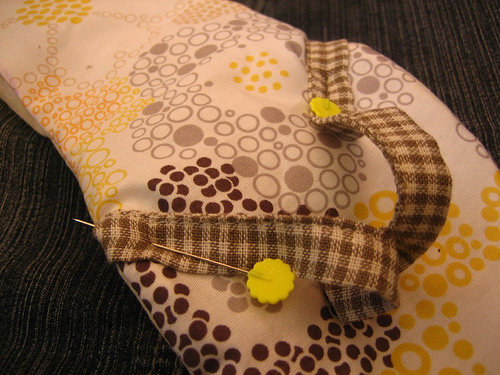
Trim the straps so that there is only 1/2 an inch pinned underneath the insole.

8. Lay the insoles on the vinyl soles, wrong sides together and edge stitch all of the way around the slipper, over the straps and closing the opening you left for turning. If necessary, trim the vinyl to match the insole.

Done! Now get comfy and stay cool!